Category:

  • Introducing Cowley Abbott’s Partnership with the Estate of William Ronald

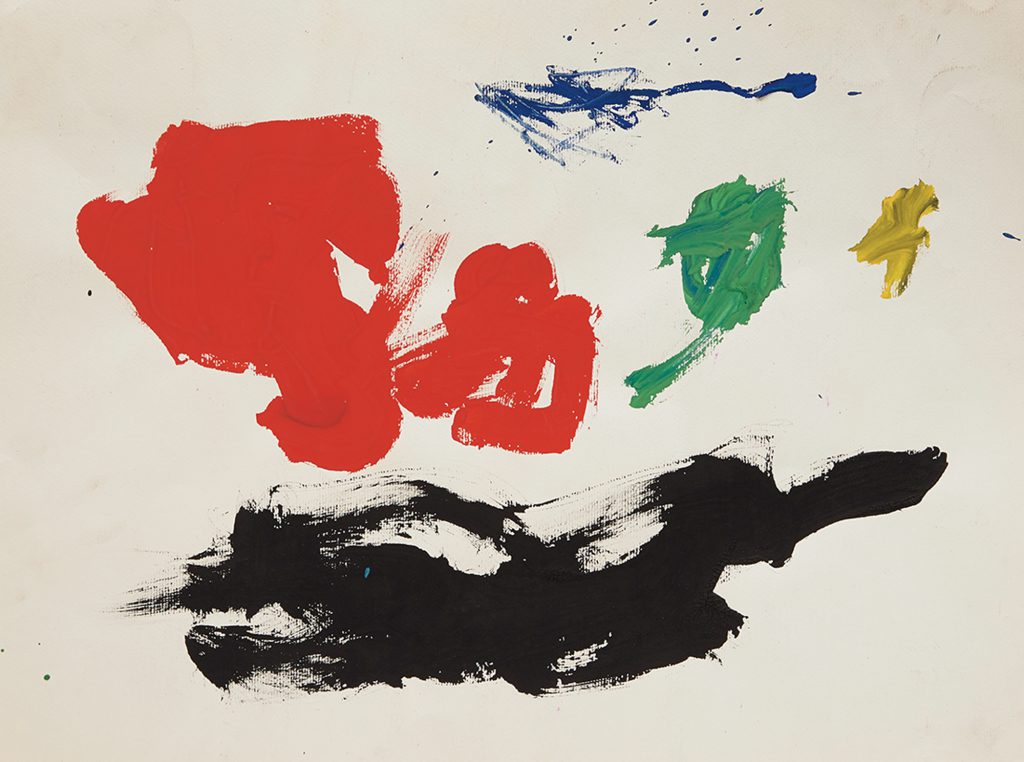
    Jack Bush, Untitled (circa 1958)
    A gift of Jack Bush to William Ronald (Collection of the Estate of William Ronald)

    Cowley Abbott is privileged to be working with the Estate of William Ronald in the offering of artwork from the artist’s collection at auction. There are currently two Cowley Abbott auctions with artwork and items from the estate: one artwork in the June live auction and a separate William Ronald estate online auction.

    We are delighted to begin this collaboration with the offering of Jack Bush’s Untitled (circa 1958) in the upcoming June 9th Live Auction of Important Canadian Art, marking the artwork’s debut at auction. The brightly coloured gouache was a gift from Bush to his fellow Painters Eleven member William Ronald. The two Toronto-based artists were prominent figures in the formation of the influential artists’ group in the 1950s. Painters Eleven helped to introduce abstract painting into the mainstream of Canadian art, which, until that point, had been dominated by the aesthetic of the Group of Seven.

    Untitled (circa 1958) was painted during a key period when Bush was breaking completely from figurative painting to embrace abstraction. During the spring of 1958, Bush visited New York City and saw the work of William Ronald at the Kootz Gallery. Ronald moved to New York shortly after the formation of Painters Eleven in 1955 and began exhibiting with Samuel Kootz in 1957.  Prior to this, Ronald arranged to have Painters Eleven invited to exhibit in the annual exhibition of the American Association of Abstract Artists at the Riverside Museum in New York City. This exposure would introduce Ronald, Bush and their peers to a wider audience and give them an international standing.
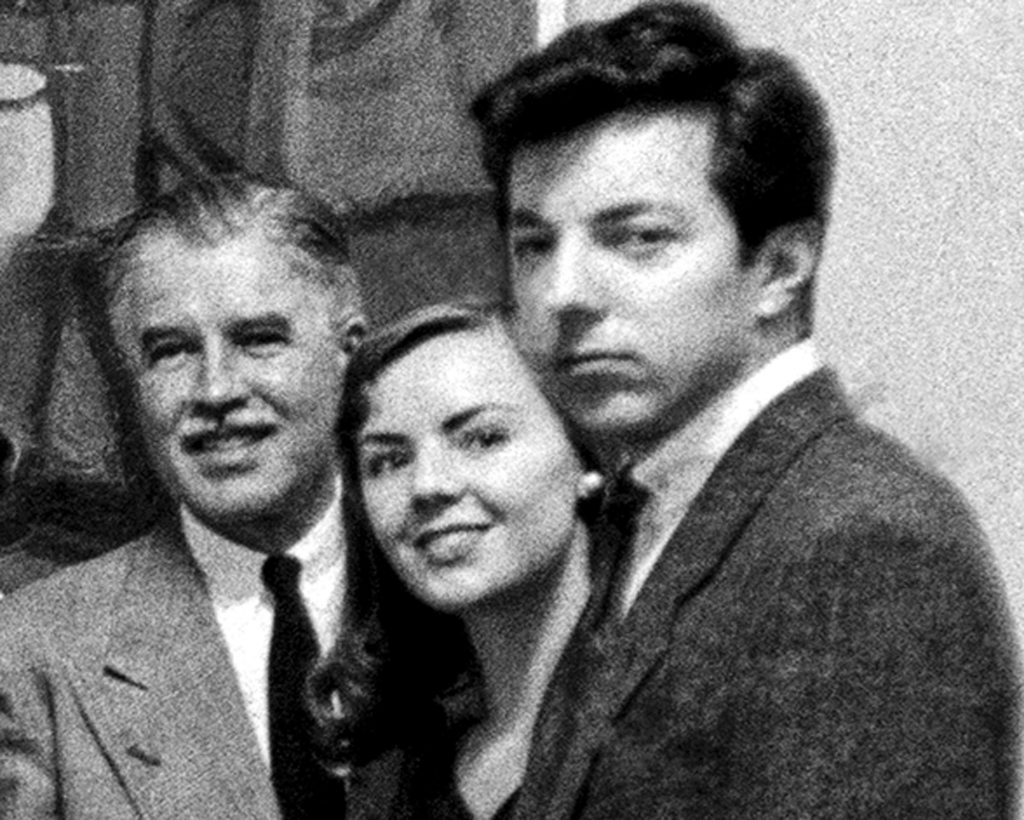
    Jack Bush, Helen Ronald & William Ronald
    at the Painters Eleven opening at the Riverside Museum, New York on April 9th, 1956
    (photograph courtesy of Helen Ronald / The Estate of William Ronald)

    Ronald became friendly with fellow abstract painters of the New York School including Mark Rothko and Franz Kline. The art critic Clement Greenberg introduced both artists to many leading Abstract Expressionists and early Color-Field painters, and praised the work of Painters Eleven. As recounted by Helen Ronald, the two painters met up one day in 1958 so that Bush could show Ronald the new direction he was taking in his painting–one that was encouraged by Greenberg. Helen remarked: “Bill was surprised that Jack still cared about his opinion, especially as he felt there may have been some lingering hard feelings over his resignation from Painters Eleven the previous year.” During this encounter, Bush presented the colourful gouache on paper Untitled (circa 1958) to his friend as a gift. Helen adds “I remember Bill describing how enthusiastic Jack was about his new direction in painting and how much he appreciated Bill’s arranging for Greenberg to visit Painters Eleven. Bill then showed me the impressive, beautiful work on paper which we’re now calling the “Gouache for William Ronald” by Jack Bush. It was totally different than any of the many paintings by Jack that I’d seen before. It made an indelible impression.”

    While Ronald gave away most of the artworks he collected throughout his life, he was so touched by the Jack Bush gouache that he held onto it for the rest of his life. Helen Ronald believes the time has come to pass the work on to a new owner, stating: “At this time in my life, I’m organizing my archive for the future. I’m pleased to say that it’s now time for someone else to take care of this beautiful work of Jack’s.” Cowley Abbott is fortunate to be offering this painting with such a unique and interesting provenance; it is rare to come across an artwork that was a gift between two famous artists. Untitled (circa 1958) will be included in the forthcoming “Jack Bush Paintings: A Catalogue Raisonné”.

    Cowley Abbott has a strong record at auction for the work of Jack Bush, including most recently the 1965 canvas Column on Browns which sold for $870,000 in December 2020. We continue to introduce rare and important examples of his work to the market, which have been consistently selling to advantage. We eagerly await this season’s live auction on June 9th, with much anticipation for the Jack Bush gouache on paper, among many other important Canadian artworks.

    Cowley Abbott has commissioned a newly written biography of the art career of William Ronald containing previously unknown information sourced from the archives of The Estate of William Ronald. The biography can be found on Cowley Abbott’s website by following this link.
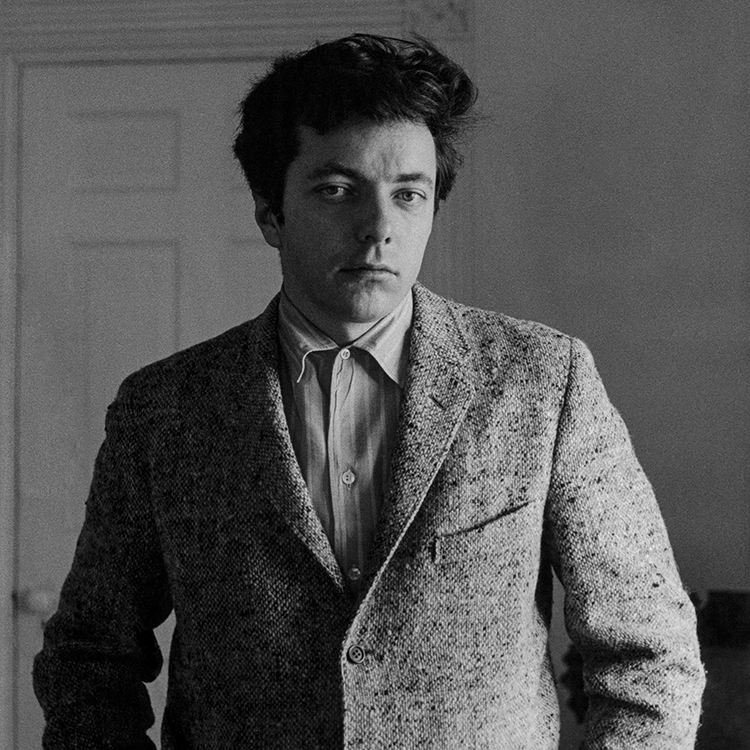
    William Ronald in 1958 in Kingston, New Jersey
    (photograph courtesy of Helen Ronald / The Estate of William Ronald)

    In addition to the offering of the Jack Bush gouache in the June live auction, Cowley Abbott is also hosting the online auction, From the Estate of William Ronald, with bidding open between May 18th and June 1st. The auction includes artwork and ephemera acquired by William Ronald as gifts and trades with artists, galleries, friends and for his charitable work, the grouping providing a glimpse into the taste and community of William Ronald. This eclectic themed auction gives art collectors the first opportunity ever to purchase items from the personal collection of this influential artist. 

    You can view and participate in the online auction by following this link

  • Collecting Opportunity: March Online Auction of Indigenous and Inuit Artworks

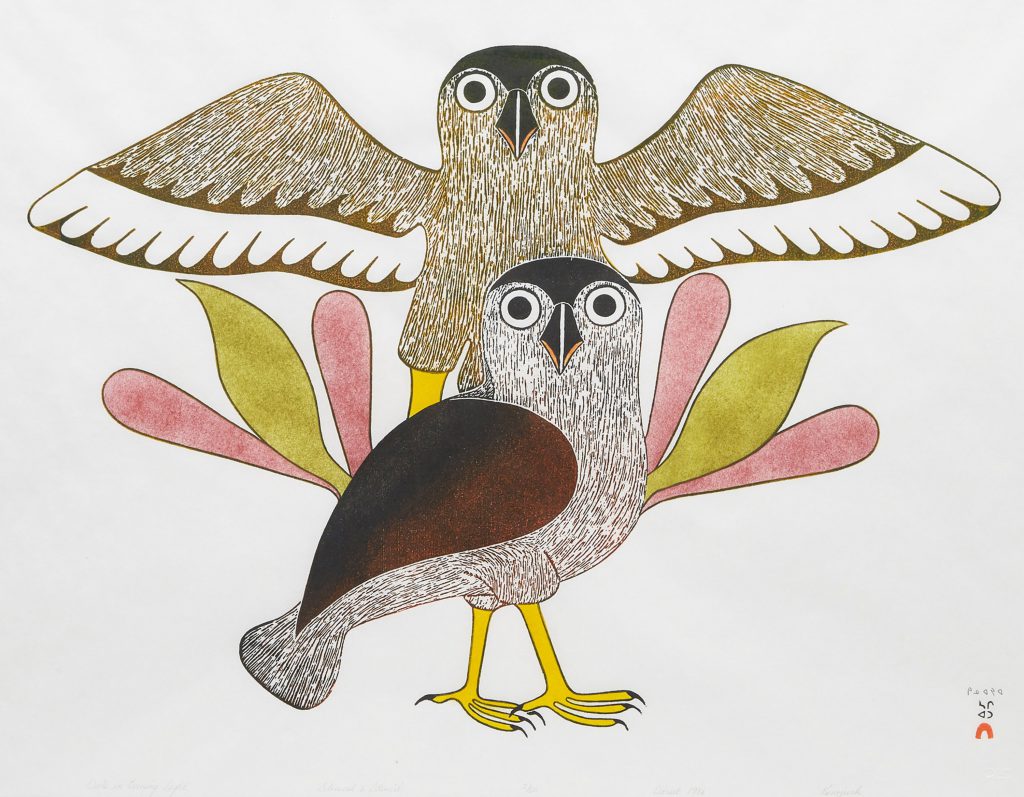
    Kenojuak Ashevak, Owls in Evening Light

    Our March 2021 Online Auction of Indigenous and Inuit Artwork offers a fantastic opportunity for collectors to diversify their collections with important works from renowned artists.

    Indigenous Art encompasses a variety of styles, practices and techniques from living cultures based outside of European, or Eurocentric traditions. Indigenous Art is the longest living art form in Canada, a highly dynamic form of art grown out of cultural continuity and expression, drawing upon themultilayered voices of people who have inhabited these lands for generations. Art is an integral part of the preservation and expression of culture, and Indigenous Art celebrates the heritage and traditions of the First Nations, Metis and Inuit.

    Cowley Abbott is pleased to present a unique selection of commanding artworks by Indigenous artists, which reflect the customs and culture of the Indigenous in an array of art forms from sculpture, to textiles, to print works.

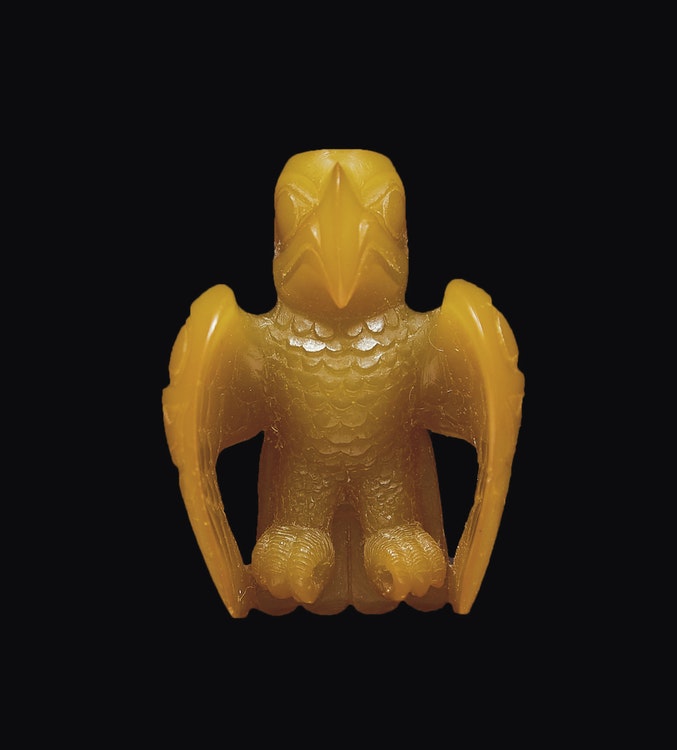
    Bill Reid, “Eagle”

    Bill Reid, Eagle

    The fusion of Haida traditions with a modernist technique is quintessential to Bill Reid’s artwork, resulting in the creation of exquisite works ranging from the diminutive to the monumental. Reid mastered several media, including carving in silver, gold, wood and argillite, referring to himself as “a maker of things” rather than an artist. He crafted objects of adornment that were variations on traditional crest designs or identity symbols, such as this delicately carved pendant. “Eagle” exemplifies Reid’s mission to express the visual traditions of his ancestors in a contemporary form, mastering his complexity of three-dimensional forms. Reid had studied the culture and myths of the Haida in the course of his research, adapting carving designs and works illustrated in anthropological literature, seeking to reference the fundamental techniques of historical Haida art. The figure of the Eagle is an important being in the oral history of the Haida, respected for its intelligence and power as a hunter.

    “Eagle” is an elegantly executed Haida-inspired design, related to a 1969 fossil ivory work, “Eagle Pendant” (Collection of Sherrard Grauer). As noted by Karen Duffek, “A pendant of fossil ivory made in 1969 presents the Eagle in a manner still related to past imagery but already hinting at Reid’s forthcoming carving, ‘The Raven Discovering Mankind in a Clamshell’ (1970, Museum of Anthropology, UBC). It is primarily in the finely carved feathers, the arched wings, and the configuration of two-dimensional elements that a continuity of image can be seen.

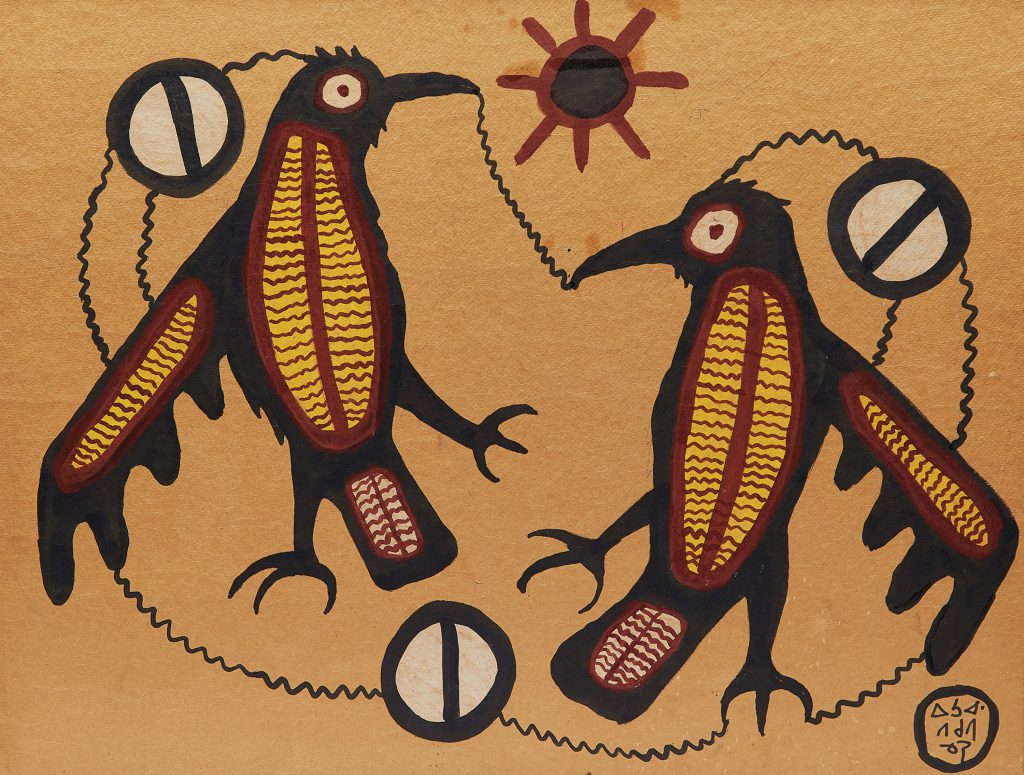
    ”Norval Morrisseau, “Thunderbird Young”

    Norval Morrisseau, Thunderbird Young

    Ground-breaking artist Norval Morrisseau, born in 1931 in Sandy Point Reserve, Ontario, worked beyond European- based conventions and drew from Anishinaabe cultural traditions to develop his powerful and unique artistic vision.Morrisseau was a member of the Royal Canadian Academy of Arts since 1970 and is celebrated founder of the Woodland School, which revitalized Anishinaabe iconography, traditionally incised on rocks and Midewiwin birchbark scrolls. A self-taught painter, printmaker, and illustrator,Morrisseau created an innovative vocabulary which was initially criticized in the Native community for its disclosure of traditional spiritual knowledge. Hiscolourful, figurative images delineated with heavy black form lines and x-ray articulations, were characteristically signed with the syllabic spelling of Copper Thunderbird, the name Morrisseau’s grandfather gave him.

    “Thunderbird Young” is an excellent example of the artist’s signature kraft card artworks with emphasis on strong line, bold colour, and articulation of his cultural heritage through visual arts.

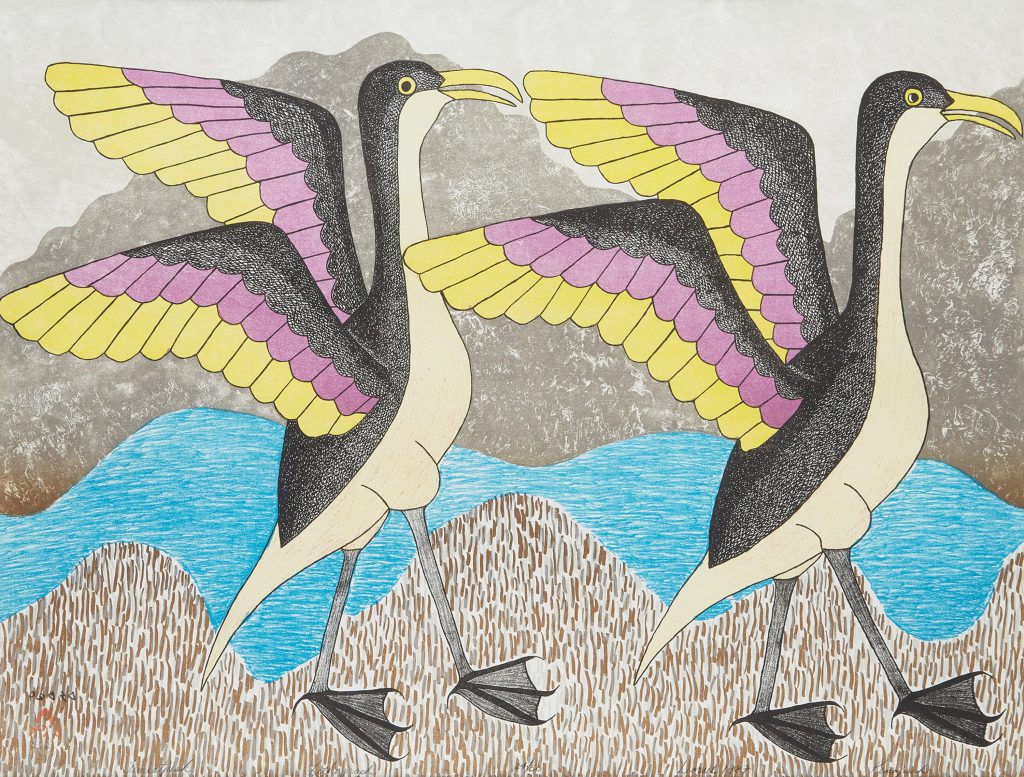
    Kenojuak Ashevak “Owls in Evening Light” and “Timiatjuak”

    Kenojuak Ashevak, Timiatjuak

    Kenojuak Ashevak has created some of the most recognizable images in Canadian art. Images of bold graphic owls in fiery reds and ink blacks are some of the artist’s most popular works. Kenojuak embraced printmaking in the 1960s and 1970s after first beginning her drawing practice in the late 1950s in Kinngait (Cape Dorset). In 1961, she was the subject of a film produced by the National Film Board of Canada on her life and work, which was key to introducing the artist more globally. Kenojuak travelled around the world as an ambassador for Inuit art and won numerous awards and honours, including the Order of Canada, a Lifetime Achievement Award at the National Aboriginal Achievement Awards, the Governor General’s Award for Excellence in the Visual Arts, and was the first Inuit artist to be inducted into Canada’s Walk of Fame.

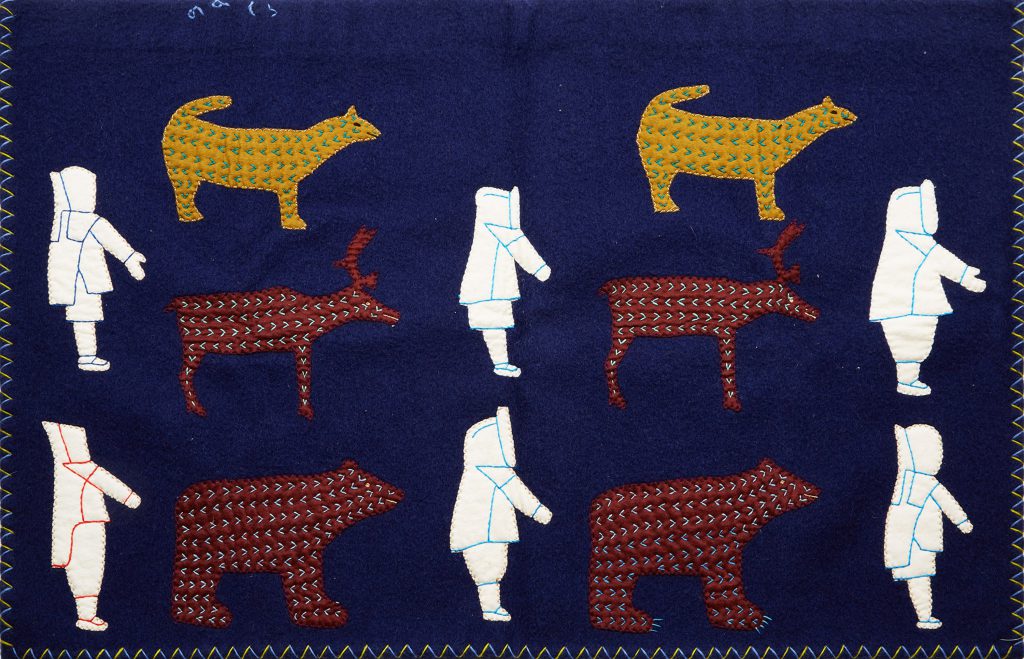
    Winnie Tatya, “Figures and Animals”

    Winnie Tatya, Figures and Animals

    Born in 1931, Winnie Tatya is a widely exhibited and celebrated multi-disciplinary artist who is recognized for her tapestry works of figures and animals. Often using brightly coloured felt to create the figures and animals, Tatya uses complementary embroidery floss to add pattern, design and texture to the works. Graphic in nature, the wall hangings make for beautiful storytelling pieces in “classically organized compositions…all tightly embroidered with great and rewarding care.” The artist has exhibited her works with the Vancouver Art Gallery, the Art Gallery of the Canadian Embassy organized by Arctic Inuit Art, the Winnipeg Art Gallery, Bayly Art Museum at the University of Virginia, among many others. Her work resides in the collections of the National Gallery of Art, the Canadian Museum of Civilization, the Edmonton Art Gallery, the Winnipeg Art Gallery, the University of Alberta, and the Inuit Cultural Institute, amongst many other prominent private collections.

    A variety of stone sculptures by artists such as Sheokjuk Oqutaq, Kumukuluk Saggiak, Napachie Ashoona, Thomassie Tukai and Johnny Tunnillie are featured in the current online auction and make for wonderful three-dimensional additions to create a dynamic, varied and powerful collection of artwork.

    For more information on this auction, our consignment process and details regarding our upcoming September Online Auction of Indigenous and Inuit Artwork, please contact us at info@cowleyabbott.ca and one of our specialists would be delighted to assist you.

    Literature Sources:

    Robert Kardosh, “Works on Cloth, Imagery by artists of Baker Lake, Nunavut,” Marion Scott Gallery, 2002, page 10

    Martine J. Reid, “Bill Reid Collected”, Douglas & McIntyre/ The Bill Reid Foundation, Toronto, 2016, page 83 for related work, “Eagle Pendant” (1969)

    Karen Duffek, “Beyond the Essential Form”, University of British Columbia, Vancouver, 1986, page 43

    Peter L. Macnair, Alan L. Hoover and Kevin Neary, “The Legacy: Tradition andInnovation in Northwest Coast Indian Art”, Toronto/Vancouver, 1984, pages 85-86

  • Canadian Artists from the Emerald Isle

    One would expect that there would be a significant number of Irish Canadian artists. The heritage and influence of Irish culture is one that is paramount to the history of Canada, with numerous Irish immigrants having moved to our country through the decades. As we explore Canadian art history and the artists who have shaped visual arts, three artists emerge who share a rich Irish heritage and have a celebrated legacy. 

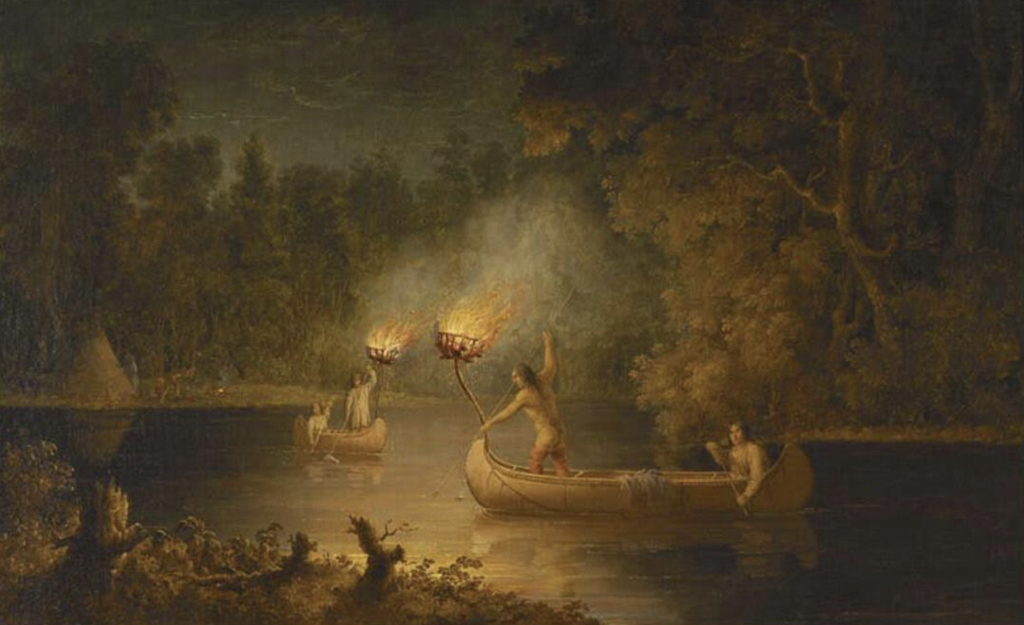
    Paul Kane, Fishing by Torch Light
    Collection of the Royal Ontario Museum, Toronto (912.1.10)

    Paul Kane, a self-taught artist of the nineteenth century, is renowned for his paintings documenting Indigenous peoples and the landscape. Kenneth Lister writes in Paul Kane, The Artist: Wilderness to Studio, that we actually don’t learn of Paul Kane’s place of birth until after his death. Kane’s birthplace of Mallow, County Cork, Ireland was revealed in the introduction of the second edition of The Wanderings of an Artist Among the Indians of North America, published in 1925. Paul’s father, Michael Kane, was an Englishman who was stationed in Ireland with the R.H.A. and married an Irish girl named Frances Loach. After Michael Kane obtained his Corporal’s stripe, he and Frances settled in Ireland for a short period. Paul was born on September 3rd, 1810 and baptized in the church of St. James on September 16th, in Mallow Parish, County Cork. Interestingly Paul’s surname was listed as “Keane” in the registry. 

    During the 19th Century, the British colony of what would become Canada was a popular destination for explorers and individuals seeking a new life, ruled by the Hudson’s Bay Company, but was a fairly unexplored land. Around 1819, Michael and Frances Kane immigrated to Canada with their children, settling in York (Toronto). Beginning in late May 1846, Paul Kane was commissioned to travel with the Hudson’s Bay Company to document the land, the Indigenous people and their customs. His depictions of the land and its people would be some of the first images Europeans would see of Canada and its Indigenous communities.

    George Hart Hughes, Tobogganing Scene

    George Hart Hughes was born on Christmas Day in Ireland in 1839. Information about the man and artist is sparse, but it is believed that Hughes started his working life as an engineer and is said to have studied under Cornelius Krieghoff, although there is no documentary proof of this. The possible influence of Krieghoff can certainly be witnessed in his compositions of moccasin sellers, habitants and trappers, informing our knowledge of historical Canadian painting. 

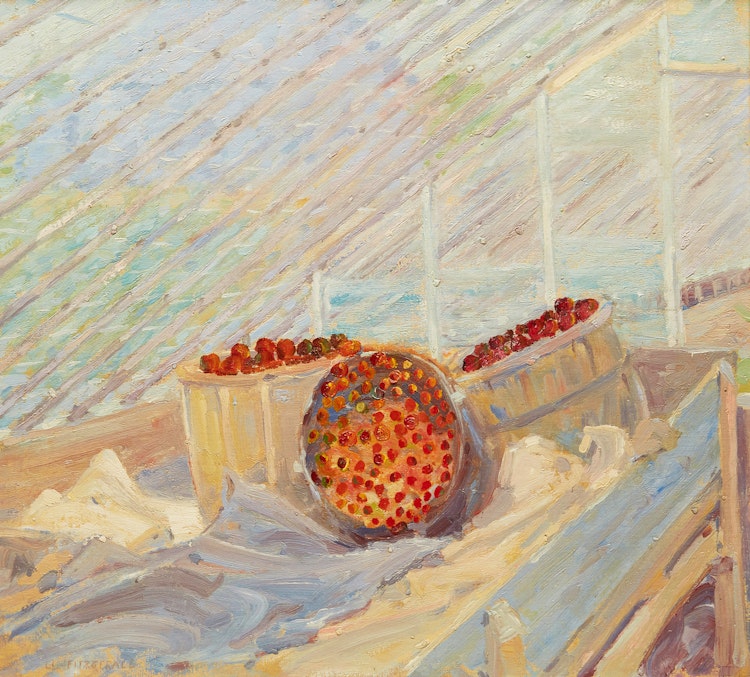
    L.L.Fitzgerald, Apples & Greenhouse

    Another Canadian artist with a connection to Ireland is Lionel Lemoine Fitzgerald. His father, Lionel Henry Fitzgerald was of Irish descent. L.L. Fitzgerald was invited to join the Group of Seven, after J.E.H. MacDonald’s death, to become the tenth member in 1932. He lived and worked mainly in Manitoba; his paintings and drawings displaying a wonderful balance between natural forms and geometric shapes. Examining his work, we can see not only the influence of the American Precisionist painters (Fitzgerald studied in New York at the Arts Students League in 1921-22), but also of Lawren Harris and the later work of Bertram Brooker.

    The Irish have played a vital role in the settlement and development of Canada and our culture. Artists, musicians and performers with Irish heritage have enjoyed acclaim nationally and internationally for generations, these three artists just a few of the many creators whose families arrived in Canada many years ago. 

    Sources: Kenneth R. Lister, Paul Kane: The Artist Wilderness to Studio, Royal Ontario Museum Press, 2010, Toronto & Dennis Reid, A Concise History of Canadian Painting, Second Edition, Oxford University Press, 1988, Toronto

  • Defining Nationhood: The Sampson-Matthews Silkscreen Project

    A.J. Casson, Algonquin Park (Sampson Matthews silkscreen)

    In conjunction with our popular February Online Auction of Works on Paper, Prints & Books, Cowley Abbott is delighted to present a special second session auction offering a selection of works from the Archives of Sampson-Matthews Ltd., which includes a variety of rare silkscreens from the Sampson-Matthews Silkscreen Project.

    A niche collecting market within Canadian art, Sampson-Matthews silkscreens are bold and iconic images of the Canadian landscape and regional ways of life. Produced with high quality oil pigments, the silkscreens have stood the test of time. The vibrant colour and drama of these artworks, created by leading historical Canadian artists, provides an excellent opportunity for collectors to build their collection with the commanding imagery of Sampson-Matthews.

    A lion in the printmaking industry, Sampson-Matthews was founded by Ernest Sampson, a pioneer of silkscreen printing in Canada, and Charles Matthews. The firm was a frequent stop for many artists working in the graphic arts and printmaking realms of art. Celebrated Canadian artists, such as A.Y. Jackson, A.J. Casson, and Franklin Carmichael all collaborated with the firm.

    Joseph Sidney Hallam, The Log Drive (Sampson Matthews silkscreen)

    One of the largest art projects in Canadian art history, the Sampson-Matthews Silkscreen Project was a defining moment in establishing the concept of ‘Canadian Art’ and a massive morale booster during the Second World War. As Joyce Zemans writes, this project was “largely responsible for shaping our notion of Canadian art and Canadian identity” (Zemans, 7). The pre-eminent printmaking firm in Canada, Sampson-Matthews Ltd., was the natural choice for a national art project.

    Spearheaded by A.Y. Jackson in 1942, the project was designed primarily for military use and evolved into an educational program with the goal to make Canadian art accessible. Moreover, the project was designed to promote a national identity, as Canada was still a young country. As a war-artist during the First World War, Jackson saw first-hand not only the horrors of war, but the way in which the military was inextricably linked to national and cultural identity.

    Jackson proposed that this project be targeted for military distribution to bases across Canada and throughout the world, eventually to expand into schools and social clubs. Over the course of the 30-year project, 118 images were produced by Sampson-Matthews, thirty-six of which were part of the wartime series. Thirty-six prints were produced after the Second World War in partnership with the National Gallery of Canada, and an additional fifteen images were produced with Sampson-Matthews after the National Gallery of Canada ceased their partnership in 1955. All of the prints were designed with between ten to twenty oil-based colours and to reflect Canadian life and the landscape, with geographic representation from across the country. 

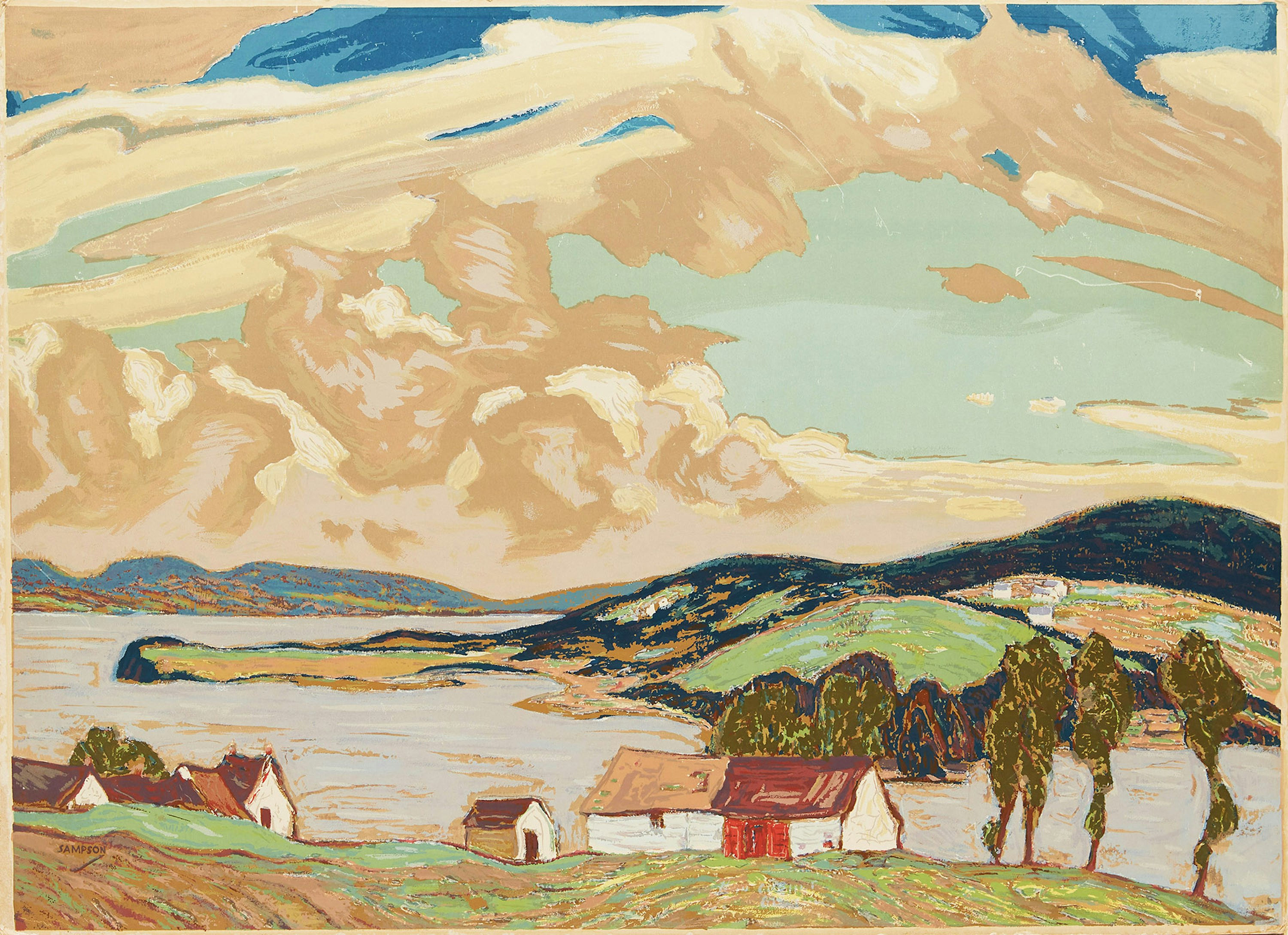
    Joseph Ernest Sampson, Gaspe (Sampson Matthews silkscreen)

    Jackson, understanding the harsh realities for artists during periods of war and the limited opportunities for sustainable work, sought to involve both young and established artists in the project, as a way to promote their work and create jobs. In late 1943, the first series of twenty-five works were completed in a large format, measuring 30 x 40 inches. A smaller size was later produced for certain images to offer economical options for the public.

    On the production side of the project, Chuck (Charles) Matthews and A.J. Casson oversaw the printing of the works. Collectors will sometimes find Casson’s signature in ballpoint pen in the lower corner or at the edge of a work, signifying that the artist personally oversaw the print’s production. 

    Images from thirty-nine prominent Canadian artists were selected, including works by: Franklin Arbuckle, Harold Beament, Bertram Binning, Fritz Brandtner, Emily Carr, A.J. Casson, Paraskeva Clark, Albert Cloutier, Alan Collier, Charles Comfort, Rody Kenny Courtice, Berthe Des Clayes, Arthur Ensor, Frederick Stanley Haines, Joseph Sydney Hallam, Lawren Harris, Hilton Hassell, Yvonne McKague Housser, Jack Humphrey, A.Y. Jackson, Arthur Lismer, J.E.H. MacDonald, Thoreau MacDonald, Isabel McLaughlin, James Wilson Morrice, L.A.C. Panton, Ruth May Pawson, Walter J. Phillips, Arthur Donald Price, Tom Roberts, Sarah Robertson, Albert Henry Robinson, Joseph Ernest Sampson, Tom Thomson, Stanley Francis Turner, Sydney Hollinger Watson, Horace Watson Wickenden and Dorothy Williams.

    W.J. Phillips, Mount Eisenhower (Sampson Matthews silkscreen)

    Through an international promotional campaign, thousands of prints found their way to the U.K., Germany, American bases, and even Russia. In 1943, Colonel C.R. Hill, Director of Special Services, noted that: “From a morale standpoint, these pictures have tremendous value. Perhaps particularly in the case of men who have been away from Canada for two or three years, the display of Canadian scenes will make them conscious of the land and cause for which they are called upon to fight. To those men who are still in Canada but who have to live under camp conditions, the pictures will bring a touch of beauty badly needed to counter act the dullness of their environment” (Zemans, 13). The project was living proof of the power of art and its ability to help define nationhood and art history in a pivotal moment in Canadian history.

    Prints from the Sampson-Matthews project are wonderful tokens of Canadian art history and are regularly sought after by collectors. For new collectors entering the art market, the prints offer a perfect entry point to acquire an iconic image by a recognized Canadian historical artist. With unique ties to Canadian military and political history, the prints allow insight into the country’s early endeavours to define a national identity and build unification within a bourgeoning and diverse country.

    A.J. Casson, Ontario Village (Sampson Matthews silkscreen)

    Cowley Abbott is pleased to be entrusted with this collection from the Archives of Sampson-Matthews Ltd., comprised of a selection of unique prints from the Sampson-Matthews Silkscreen Project, as well as Canadian historical artworks and artifacts. For more information on this forthcoming auction and project, contact our specialists at 416-479-9703 or info@cowleyabbott.ca

    Sources

    Joyce Zemans, “Envisioning Nation: Nationhood, Identity and the Sampson-Matthews Silkscreen Project: The Wartime Prints,” Journal of Canadian Art History, Vol. 19, no. 1 (1998) pages 6-51

    The Sampson-Matthews Print Collection:http://www.sampsonmatthewsprints.com/

  • Collecting Opportunity: January Post-War and Contemporary Art Auction Highlights

    Cowley Abbott is pleased to launch into the new year with our January Online Auction of Post-War and Contemporary Art. Comprised of fantastic works by blue-chip Post-War Canadian artists, practicing Contemporary artists, and hidden gems, this sale offers the opportunity for new and seasoned collectors alike to build their collections.

    We’ve highlighted a few of the great artists and artworks included in this thematic sale and their significance to the canon of Canadian art history. This dynamic auction offers buyers the opportunity to inject colour, vibrancy, and modern aesthetics into their collections, while allowing a complex dialogue between works over a range of styles, themes and movements.

    Ecology and The Canadian Landscape

    Steve Driscoll, Lagoon
    Steve Driscoll, Lagoon

    Two works of particular note in our auction are Lawrence Paul Yuxweluptun’s ink drawing “Untitled” and Steve Driscoll’s mixed media “Lagoon”. Integral to both artist’s practice is the effect of human contact on the landscape.

    Lawrence Paul Yuxweluptun, Untitled
    Lawrence Paul Yuxweluptun, Untitled

    Cowichan/Syilx First Nations contemporary artist, Lawrence Paul Yuxweluptun is one of the most sought-after artists in contemporary Canadian art. Yuxweluptun’s strategy is to document and promote change in contemporary Indigenous history, infusing his art with Coast Salish cosmology, Northwest Coast formal design elements, and the Western landscape tradition. His work incorporates components from Northwest First Nations art, as well as evocations of the Canadian landscape painting tradition derived from the Group of Seven. The figures included in his works are not necessarily representations of real people, but instead act as a visual comment on Indigenous identity within the Canadian physical and social landscape. This diminutive work, though small in scale, exemplifies complex and weighty theories of colonization, Indigenous identity, social politics and questions Canadian national identity.

    Steve Driscoll, a Toronto-based artist, is known for his mesmerizing urethan-based paintings of bold neon colours morphing and marrying into each other, creating expressive representations of the Canadian landscape. Toronto-based curator Bill Clarke explains that Driscoll’s works are “More than just re-imaginings of the landscape, his paintings, materially and conceptually, also illustrate how advancements in technology are shaping our interactions with the world and supporting innovative approaches to art-making.” “Lagoon” offers a psychedelic close-up view of the shimmering surface of a lagoon, with the abstracted currents and fauna hypnotizing the viewer. We are pleased to be entrusted with this commanding work by an important contemporary artist.

    Blue Chip Post-War Art

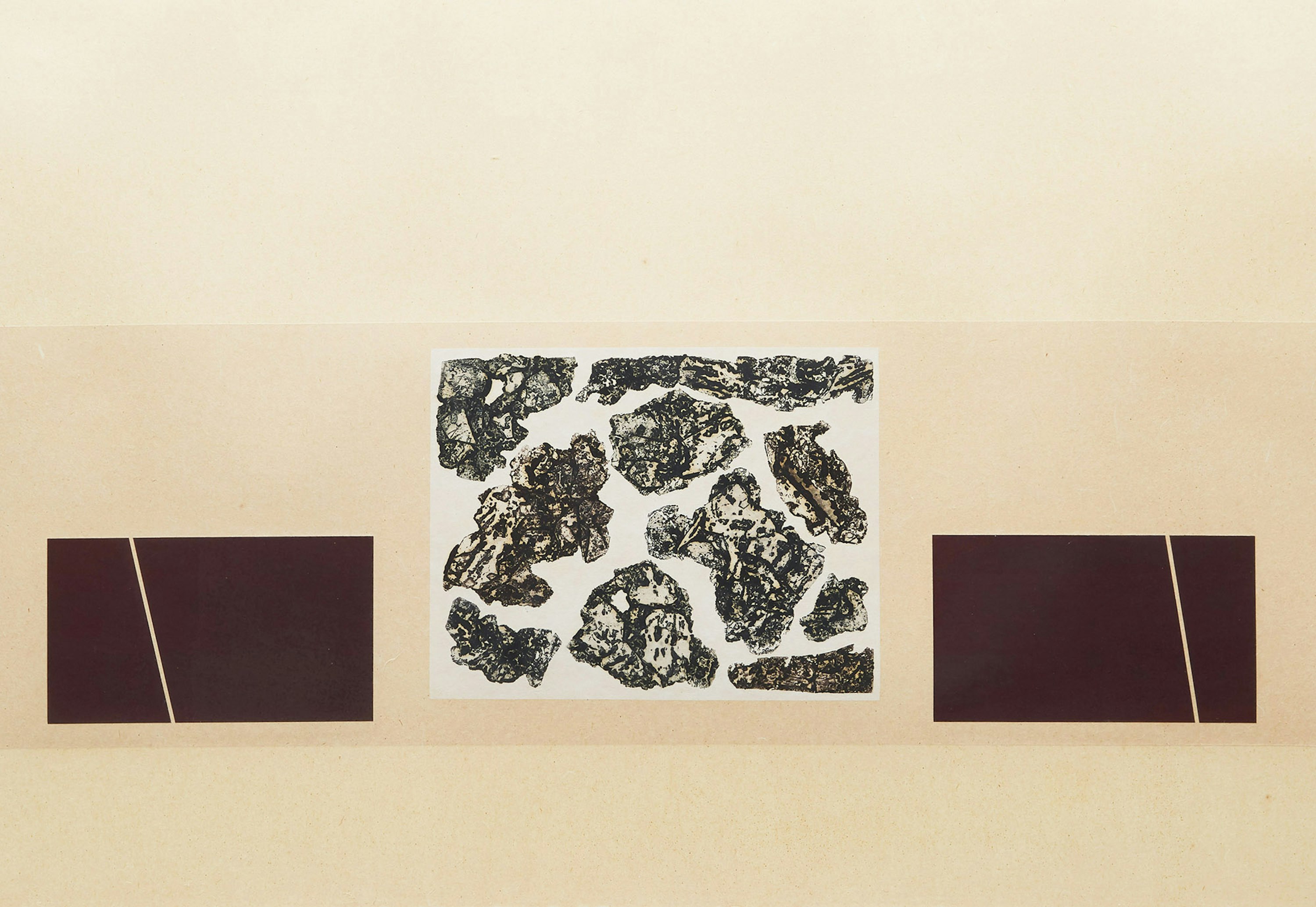
    Yves Gaucher, Silences
    Yves Gaucher, Silences

    This auction introduces wonderful examples of works by celebrated Canadian Post-War artists. Aligned with the movements of Minimalism, hard-edge abstraction, conceptual art and bold expressionism, artworks by Yves Gaucher, Gershon Iskowitz, and Roy Kiyooka present an opportunity for collectors to diversify their collections with blue-chip artists who helped shape contemporary art practices.

    Gershon Iskowitz, Untitled Abstraction
    Gershon Iskowitz, Untitled Abstraction

    Yves Gaucher’s “Silences” exemplifies the artist’s minimalist approach as a rebellion to conventions of printmaking. Calm tonalities, geometric form and expanse of space provide an arena for introspection. Whereas “Untitled” by Gerson Iskowitz offers a bold expressive space, highlighting the artist’s signature exploration of colour relationships. An artist with a distinct style of his own, not fully aligning with abstraction or representation exclusively, Iskowitz produced these fresh watercolour works throughout his career as an exploration of the limits of the medium and colour relationships. The resulting organic forms bleed into one another and float ethereally across the paper.

    Roy Kiyooka, Abstraction
    Roy Kiyooka, Abstraction

    The experimental Roy Kiyooka is represented in the auction by two distinct works. The artist’s early 1959 experimental watercolour “Abstraction”, which oscillates between abstraction and representation, is in contrast to a more contemporary 1971 conceptual gelatin silver print “StoneDGloves”. The former exemplifies the young artist’s explorations with watercolour and abstraction under the influence and tutelage of Jock MacDonald at the provincial Institute of Technology and Art. “StoneDGloves” presents a dramatic shift towards conceptual art in photography. This work was a part of a photographic series taken by the artist at the construction sites of Osaka, Japan at the time of Expo ’70. Kiyooka photographed various discarded workmen’s gloves which had been petrified in cement on worksites. The series recalls art theories of trace and ephemerality while exploring the poetic relationship of human interaction with the evolution of the landscape. The Collection of the National Gallery of Canada holds 18 photographs from this series, including this image.

    Pop Colour and Aesthetics

    If you are looking to add a bold splash of colour to your collection or acquire playful op-art, works by Max Johnston, John MacGregor, and Burton Kramer would be perfect additions.

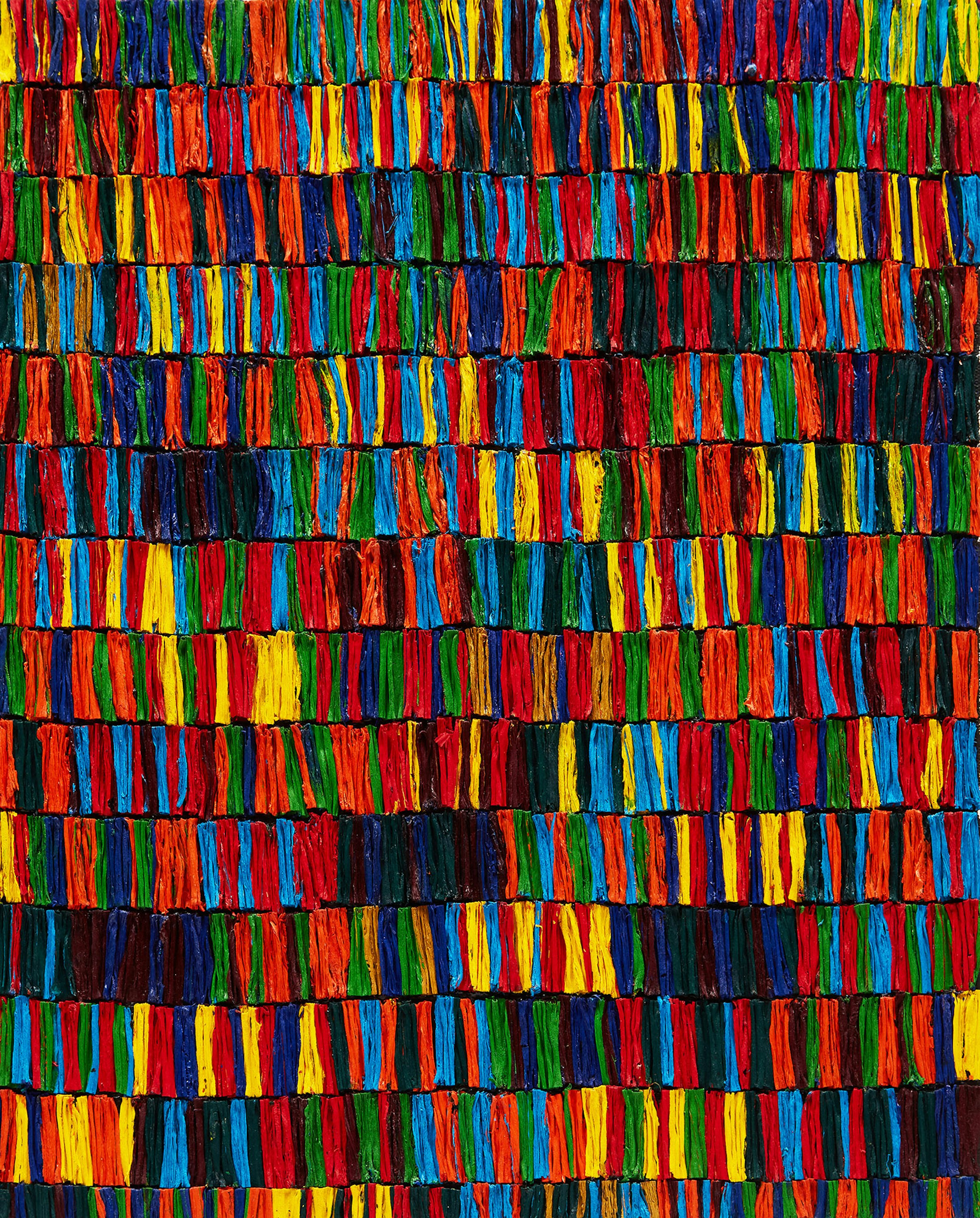
    Max Johnston, Wholeness in a Collective Compression
    Max Johnston, Wholeness in a Collective Compression

    Max Johnston’s “Wholeness in a Collective Compression” is an excellent example of the artist’s experimentation with the limits of paint as a medium. Moving towards sculptural application of the paint, this piece showcases Johnston’s physical language of paint on the two-dimensional plane. A vibrant technicolour display, this piece instantly inspires energy while adhering to the modernist grid.

    John MacGregor, Ripple Time (Multi-Colour)
    John MacGregor, Ripple Time (Multi-Colour)

    Throughout his practice, John MacGregor has investigated the effects of time on ordinary objects. Chairs, clocks, rooms, and objects are distorted on the image plane as a characterization of bending space and time. The artist explains:  

    “I have always been fascinated by the concept of time. What it might be, how it is perceived, how it is represented and what it symbolizes. We live in a society that is structured and regulated by a symbol of time. We have come to accept this symbol as a valid and real expression of what time is. However, this acceptance has been at the expense of our intuitive and subjective feelings about time. Clocks have forced us to view time as detached, regimented and a structured entity that has a reality separate from ourselves. The equal intervals and numbers on the face of the clock further this perception.”

    Both “Ripple Time (Multi-colour)” and “Squeezed Time” employ surrealist and op-art aesthetics of morphed and distorted objects in a play of the visual plane of depth and dimension. This manipulation of form represents the artist’s investigation of metric time as a modern social construct and the power it wields over our core functions. Playful and contemplative, the works immediately energize the viewing space and engage the viewer with their own temporal experiences.

    Burton Kramer, Garden Music
    Burton Kramer, Garden Music

    Finally, Burton Kramer’s fresh geometric canvas entitled “Garden Music” brings forth memories of effervescent symphonies. The artist is famously known as the graphic designer for the iconic 1974 Canadian Broadcasting Corporation logo with the radiating, stylized ‘C’. Through his fine art practice, Kramer is renowned for his experiments with synesthesia of colour and music, exploring the language of visual forms and sound as the eye dances along the exuberant canvas of fresh pigments.

    Cowley Abbott is delighted to be entrusted with a variety of rare and stunning works in the current Post-War and Contemporary Art Auction. The full catalogue of artworks included in our January online auction can be found here, presenting a plethora of paintings, sculpture, works on paper and innovative mixed media pieces by renowned artists. Contact our team for further details on this sale, the bidding process and how we can assist you to build your collection with Cowley Abbott.