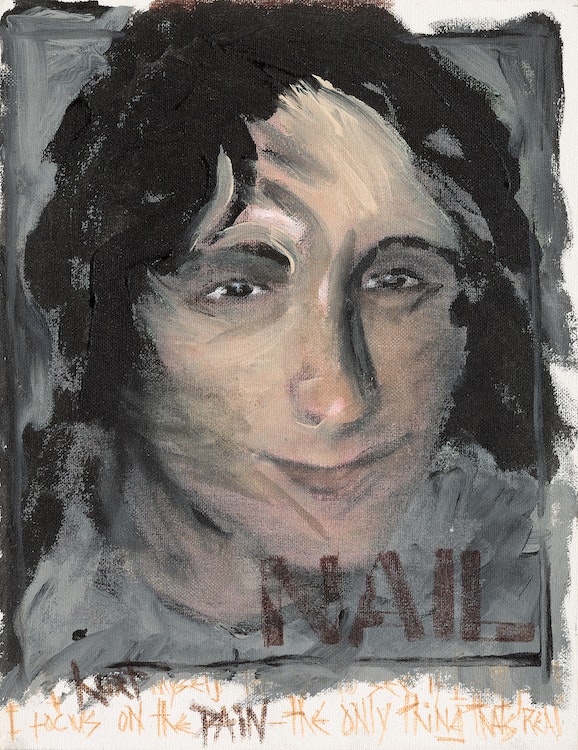
According to the David Bowie expert Andy Peters: “This artwork is another ‘DHead’ of Trent Reznor and includes part of the lyrics written in David’s hand at the foot to NINs big hit ‘Hurt’ which is a unique selling point. This painting never existed in his original inventory of 66 official DHead paintings most of which were made commercially available and was instead part of the rumoured extra 40+ ‘nonpublished’ DHeads he had also created in the period between 1994 and 1997.”
In 1995 Nine Inch Nails opened for David Bowie on his Outside Tour, where he sang ‘Hurt’ with Trent Reznor. During their time spent on tour together in the 1990s, a close friendship was born that lasted until Bowie’s death in 2016. Most famously, they collaborated on ‘I’m Afraid of Americans’, a single from Bowie’s album Earthling.
We would like to thank Andy Peters at davidbowieautograph.com for his assistance with researching this artwork.
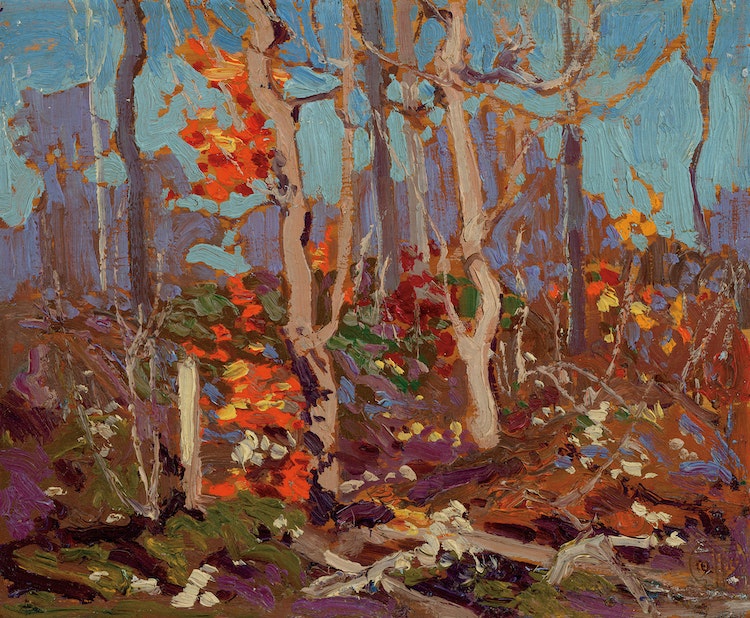
Included in exhibitions for over a century and once part of the collection of the artist’s family for over fifty years, Tom Thomson’s Ragged Oaks makes its auction debut with Cowley Abbott this spring season. Canadian art historian and Tom Thomson scholar, Joan Murray, notes that 1916’s Ragged Oaks is a magical and vigorous quintessential Thomson painting in which balance is the key to beauty, from the oaks off-centre to the foliage and bush, to the colours used throughout.
In the Cowley Abbott spring catalogue, Murray describes the power of the composition where the two oak tree trunks are depicted in a location of spectacular beauty. The leaves tumbled on the ground and the brilliant orange foliage and bush to one side balanced by bright leaves on the other reveal a scene of sparkling vitality, with all the liveliness Thomson wished to record and which appear in his best works. From the background tapestry of distant trees to the scattered logs of the foreground, the painting practically hums with energy, but the energy is matched with the harmony of Thomson’s excited palette.
Tom Thomson Ragged Oaks, 1916
Murray describes Ragged Oaks as one of Thomson’s best sketches of 1916, the artist’s “golden year”, where he recorded varied configurations of the trees he countered; from Ragged Oaks through to those we see in the sketches for two of Thomson’s most well-known works, The Jack Pine and The West Wind.
The year is inscribed on the reverse of the panel, as well as, “Not For Sale”. Not surprising, given the quality and vivaciousness of Ragged Oaks. The painting was once owned by Fraser Thomson, Tom’s youngest brother. Fraser described the composition to a biographer in 1930: “A Cobalt blue sky with two ragged oak trees a little off centre with two patches of foliage in glowing color with foreground in green Brown purple manner with Blue + yellow, a real painting”.
The private collectors acquired the artwork from the Fraser Thomson’s family in 1971 and it was a treasured gem within their museum-quality collection. Ragged Oaks is featured in Cowley Abbott’s Auction of Artwork from an Important Private Collection on June 8th.
William Kurelek was a skilled storyteller, whose work provides his insight related to a wide variety of personal subjects which often focused upon his life, heritage, and religion. Kurelek’s most celebrated compositions continue to be those which reflect his upbringing and memories of life on the farm. The painter’s work explored both the tender and the gruelling aspects of daily life on the Prairies, the scenes populating the 1964 Isaacs Gallery exhibition An Immigrant Farms in Canada, the first of several such shows which Kurelek would present.
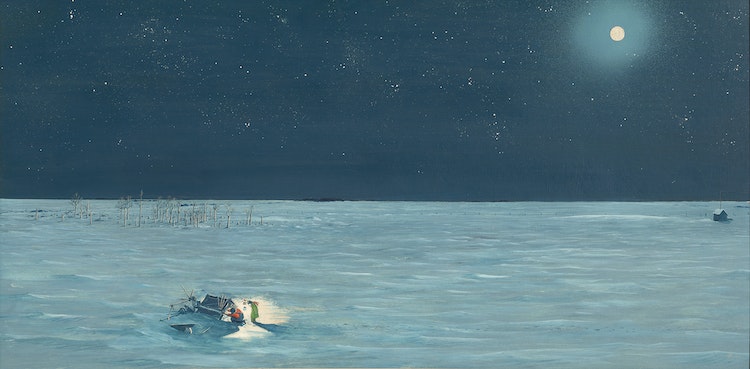
William Kurelek “A Bolt Like That”
This painting, A Bolt Like That, painted in 1965, was not featured in these exhibitions, however it does appear in William Pettigrew’s 1967 National Film Board documentary, Kurelek. The captivating beauty of Kurelek’s expansive prairie landscape led the owner to purchase the painting from Toronto’s Isaacs Gallery soon after it was painted, A Bolt Like That remaining in their collection for close to sixty years, soon to make its auction debut with Cowley Abbott during the June 8th Live Auction of Important Canadian & International Artwork.
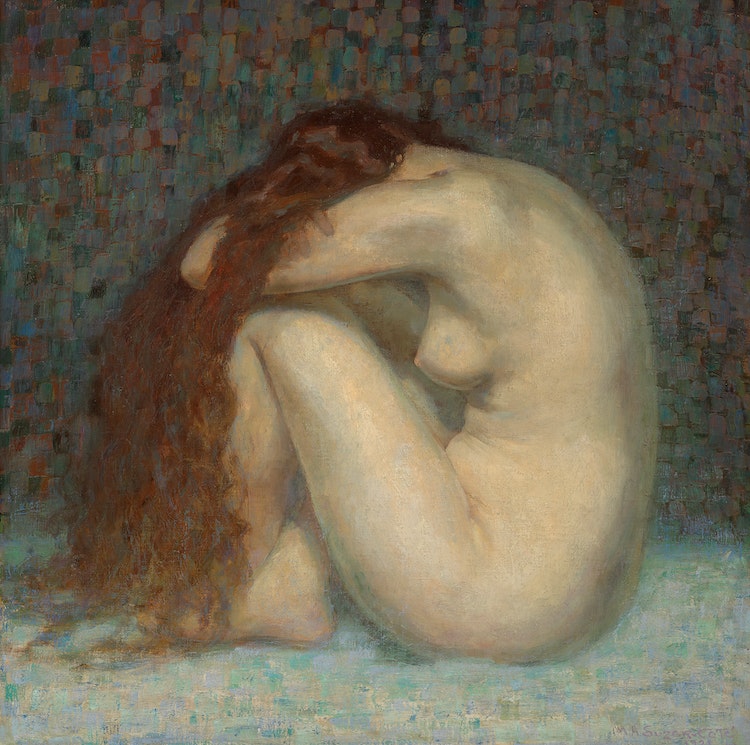
Marc-Aurèle de Foy Suzor-Coté had a long practice of studying the female model, a rare subject matter for painters of the period. In 1921 the artist presented Magdalena for sale at $2,000, an unprecedented amount. The artwork was well received by Montreal critics at the time. The curled up position of the woman challenged the stereotypical excellence of the feminine form, a masterful depiction of the nude by a celebrated Quebec artist.
Fernando Botero is a celebrated Colombian artist renowned for his paintings and sculptures that explore and experiment with the proportion and size of humans and animals. The artist’s tactile and sensual approach to the representation of rotund, whimsical figures in his paintings is a hallmark of his singular style. Consistently manipulating space and perspective, Botero is influenced by his studies of the Italian Old Masters and discovery of modern artistic movements, such as Abstract Expressionism. Botero remains connected to the artistic culture of Latin America in his oeuvre, inspired by Spanish master painters and Mexican muralists, while exposure to modernist influences have expanded his painterly practice.
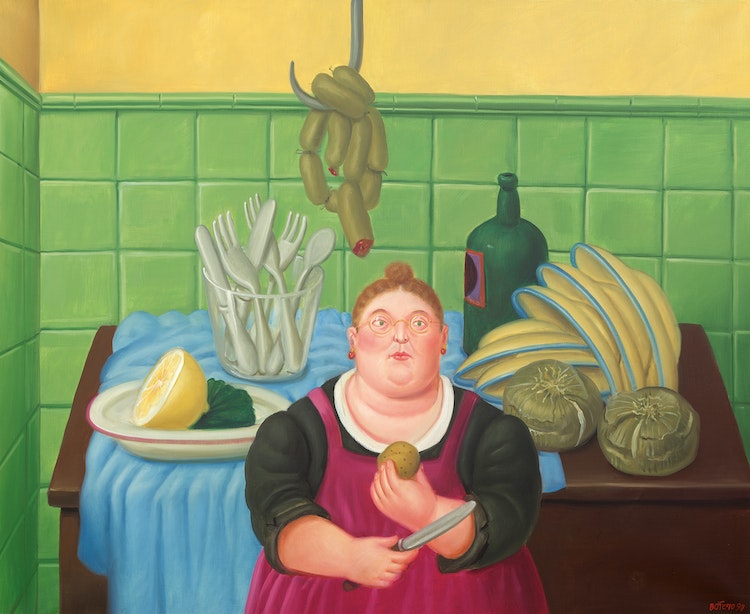
Fernando Botero The Kitchen
In “The Kitchen”, Fernando Botero has created a sense of unease with his placement of a lone female figure directly in the center of the composition. The expression on the figure’s face is unreadable. Botero has captured the figure in the middle of the simple culinary act of peeling a potato with knife in hand, frozen by the intrusion of the viewer’s gaze. She is one of the artist’s characteristic voluminous matronly figures and is depicted in one of the most important locations in a home, the kitchen.
The table behind the female figure presents an abundant still life, set against vibrant green tiles. Fresh sausages hang on a meat hook to dry just above a glass vase filled with knives, forks and a single spoon. A large bottle of wine and a collection of yellow dishes are stacked, ready to be used for serving. Two large, juicy onions and a perfectly ripe lemon that has been sliced in half complete the still life arrangement, all presented on top of a gathered blue tablecloth.
John Sillevis writes: “There is certainly a reference to the masterpieces of Dutch seventeenth-century still life in Botero’s predilection for ‘la nature morte’. Botero is able to create the most extraordinary effects in his still lifes. He inserts a sense of menace or uneasiness into an arrangement of fruits and flowers. In Dutch art of the Golden Age, still life painting also had different layers of meaning.” Dutch genre painting was not simply a depiction of ‘everyday life’, but incorporated elements to convey moral overtones, remarking upon the vanities of worldly pleasures and the dangers of vice.
Botero’s paintings of the 1990s were often explorations of the still life in various forms, employing painterly devices and drawing upon the thread of Dutch genre painting. The overt symbolism of “The Kitchen” is revealed through the various objects Botero has chosen to include. The sliced lemon can be read as sourness or bitterness, but it can also serve as a symbol of ephemerality or the passage of time. The word for onion comes from the Latin uniothat, meaning oneness or unity, and the bottle of wine, which is always associated with the divine, may also symbolize prestige, uniqueness, wealth, and integrity.
Botero’s quintessential use of flat, bright colours and boldly outlined forms in this painting are characteristic of his signature style, while the inclusion of foods found in a traditional Colombian kitchen add a layer of nostalgia to this monumental painting. “The Kitchen” captures Botero’s enduring fascination with the tradition of still life painting, presenting the art form as current and contemporary.